
POSTED
September 24, 2026
Key takeaways from our World Water Week session on menstrual health and dignity in climate-vulnerable and water-insecure contexts.
Two of Pakistan's provinces are named after water. Punjab is panj āb, five rivers braiding across a plain that has grown wheat and cotton for thousands of years. Sindh is named for the Indus, the river that named the subcontinent before it named the province.
And yet. Ask a household in Sindh how far someone walks to fill a container, and the answer comes back in kilometres. Ask in canal-fed Punjab, where water is less scarce than it is unreliable, and the question stops being how far and becomes whether it is safe, and whether it will be there tomorrow.
Water shapes everything here, including, almost entirely unrecorded, who gets to menstruate with dignity.
That is the share of 550 menstruators surveyed across Punjab and Sindh for the Sang pour Sang Uni·e·s pour la Dignité baseline survey who reported menstrual discrimination. What is striking is not that the figure stands out. It is that it barely does. Across all nine countries in the study the numbers land in much the same place, and the drivers of exclusion are the same everywhere: inadequate WASH, pain and stigma.
But a quieter figure should stop us. Only 11% said their preferred product was available and affordable — in the country with the lowest average product cost recorded anywhere in the study, $1.19 a month.
Lowest is not the same as affordable. What a product costs in dollars tells us little about what it costs against a household income, and that figure captures none of what sits around it: the fuel to heat water, the utensils, the hours spent walking to fetch it. Price is part of this. It is not the whole of it. Availability, choice, water, sanitation and stigma are interwoven with it.
We built our World Water Week session around Pakistan for two reasons. It is among the countries climate change is hitting hardest — floods, cloudbursts and displacement that strip away what sanitation exists and contaminate what water is left. And its menstrual health and dignity sector is doing some of the most inventive work anywhere.
Our online session, moderated by Dr Deborah Maufi of PSI Europe, brought three vantage points to that weave.
Qamar Naseem is Programme Manager at Blue Veins in Peshawar, which is helping establish Pakistan's first government committee on dignified menstruation. He works in Khyber Pakhtunkhwa districts where households ration water, and fetching it can mean kilometres of walking for a few litres.
"The family has to choose whether the water should be used for drinking, for cooking, or for menstrual management, which is, of course, a very difficult decision."
Reusable products need water to wash and space to dry. Dry pit latrines are still standard in places, and many households share one toilet, so there is nowhere private to change or dry anything. Asking whether water is available, he argues, is not the same as asking whether it is safe, private, reliable, and enough.
"Menstrual dignity and water security are not two separate issues."
That household decision — drinking, cooking, or managing a period — is rarely made by the person menstruating. In Pakistan, men frequently control household spending and how scarce water is allocated, and they occupy the positions that decide whether menstrual needs are funded or ignored. Blue Veins therefore engages men and boys deliberately: if water is rationed by someone who has never been told what menstrual management requires, menstrual needs are the first to be cut.
"Menstruation cannot only remain a conversation between menstruators. We really need men and boys as informed allies in removing the stigma."
.jpeg)
Working with displaced Afghan families in camp settlements, Blue Veins also found that sun-drying reusable menstrual products was among the biggest problems women named, even after products had been provided. Too many programmes stop at handing over products.
This is why Sang pour Sang Uni·e·s pour la Dignité has adoptedthe “3P approach” — person, pocket and planet — to guide product design across the initiative, an approach Blue Veins applies.
"Does this protect the person, their dignity and their health? Even when the product is free, there are associated costs: utensils or wood for heating water. So, we consider the pocket. And the planet: water use, disposal, climate resilience."
A product that cannot be safely maintained where it is used has not delivered dignity. Hence his ask: make menstrual health and dignity a mandatory, measurable component of gender-responsive water, sanitation and hygiene (WASH), justice and climate frameworks, not an optional add-on.
Jayaa Jaggi founded She Matters, which works with religious minority women and menstruators with disabilities. Its move into water infrastructure came from one question during flood recovery, while distributing menstrual cups. A woman asked whether she was supposed to boil the menstrual cup to clean it. The nearest water source was still recovering from saline intrusion after the floods, and the little clean water reaching her house was going to drinking.
"We were handing her a technically superior, more sustainable product, but she had no safe way to use it."
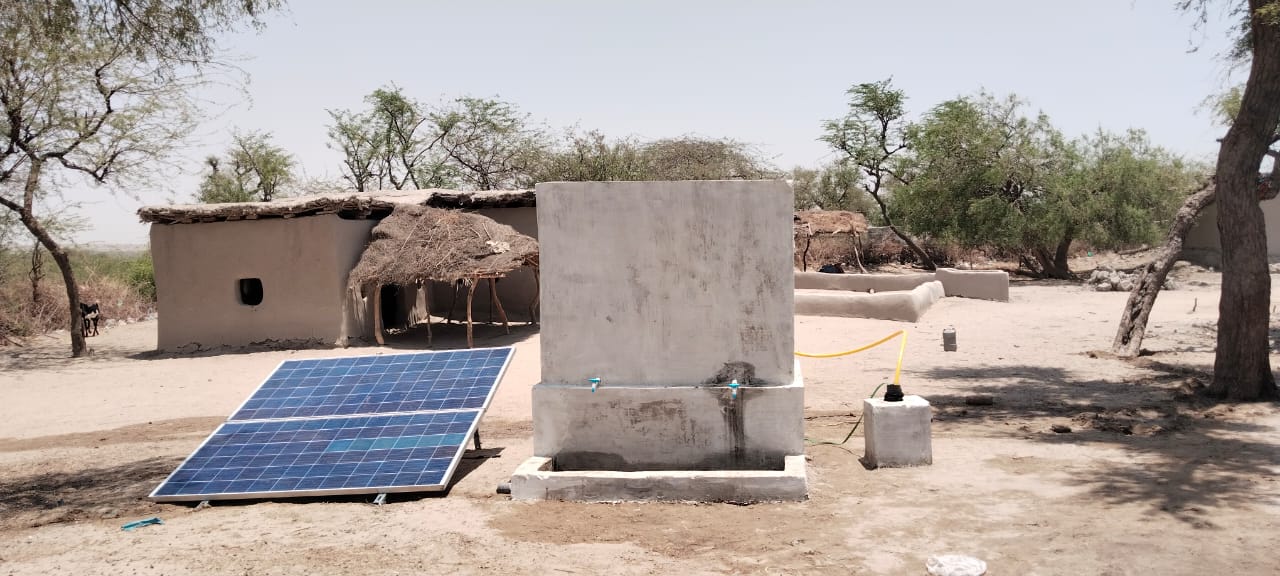
She Matters now installs solar submersible pumps — pumps that sit below the water line in a borehole and lift groundwater to the surface, powered by solar panels rather than diesel or an unreliable grid. They keep water flowing without fuel costs, and they shorten the walk to fetch it.
"We were building menstrual health programming as if water was a constant. We realised it was a variable in the entire system."
The same inclusive lens runs through the rest of the organisation's work: information in braille and sign language, training for caregivers, audits of disaster-response manuals, murals in public space. The point is reach. A menstrual health session delivered only in speech excludes a girl who is deaf; a latrine reached by steps excludes a wheelchair user; a disaster response that has not trained its volunteers to communicate across disabilities will leave people behind precisely when the water is least safe. Designing for the people furthest from the service is what makes it work for everyone else.
Jibran Bahadur Khan, Founder and CEO of Karachi-based Swift Hygiene Industry, builds a pad's absorbent core from cotton cellulose recovered from textile-mill offcuts, the same cotton economy those rivers irrigate. A conventional core takes 7–36 litres of forestry and milling water per pad. Theirs takes 0.225 litres.
"Water security should not only be considered when we design a water system. Most of us think about agriculture or textiles but it is also about product development and the raw materials used in any particular product."
There is a resilience argument underneath the environmental one. Wood pulp comes from a handful of forested economies, so most manufacturers import it; building the core from domestic mill waste means the supply chain holds when global trade does not. Asked bluntly whether the circular model costs more, he was equally direct: it costs less, and the saving goes to the buyer, not the margin. Their pads sell at 99 Pakistani rupees for a pack of six, aimed at peri-urban and underserved markets.
The rivers that named these provinces are still running. What sits between them and a dignified period is a set of design choices: whose needs a system is built around, and which costs get passed quietly to a household. A few key takeaways:
One honest gap, reported back from the breakout rooms by Jayaa Jaggi: the same communities have not been tracked over multiple climate shocks to see whether climate-resilient water infrastructure actually improves menstrual health and dignity in the long run. We only have one-time snapshots, rather than evidence over time.
"No period anywhere in the world is managed without water. The next time you design a water system, a climate adaptation plan or a humanitarian response, ask who it is designed around. If the answer does not include people who menstruate, the work is not finished."
— Dr. Deborah Maufi, Women's Health Consultant, PSI Europe
Sang pour Sang Uni·e·s pour la Dignité is a global initiative to end menstrual discrimination and advance menstrual health and dignity. Led by Fòs Feminista with Equipop, the Global South Coalition for Dignified Menstruation and PSI Europe, and funded by the Agence Française de Développement, it works across nine countries: Benin, Cameroon, Côte d'Ivoire, Guinea, Nigeria, Pakistan, the Philippines, the Dominican Republic and Haiti, alongside close to 100 local partners.


You will be redirected in 5 seconds.


